
Loss and damage in Burundi’s Ruzizi estuary region.
by Tomas Van Acker & Jean-Paul Nizigiyimana
In recent years, the issue of ‘loss and damage’ (L&D) has dominated high-level climate diplomacy and policy discussions. L&D is a term used analytically to refer to the negative impacts of climate change – losses and damages – that occur in the absence of sufficient or appropriate mitigation or adaptation measures. At the same time, L&D refers to the emerging field of policy responses to address these negative impacts. Discussions on these responses have become a major bone of contention in climate negotiations. Global South countries have called for a separate pillar of climate finance, alongside mitigation and adaptation funds, to address current and projected L&D.
Richer countries in the Global North have been reluctant to do so. While such a funding mechanism has finally been established at recent COP conferences, it remains to be seen whether it will be able to address the huge L&D challenges already faced by Global South countries, whose financial capacity is insufficient to deal with L&D. This is not just a question of putting enough money into the fund, but also of ensuring that such a fund can respond to challenges swiftly, but also appropriately and in a climate just manner.
It is therefore important to understand how L&D is playing out in frontline communities. To do this, we turned our lens on Burundi. Ranked among the 25 countries most vulnerable to the impacts of climate change, (notre dame link) Burundi today faces a range of climate-related hazards, mostly related to erratic and more intense rainfall, but also to rising temperatures, resulting in a variety of sudden and slow-onset impacts. These are already affecting the economy, infrastructure and health of people throughout the country, which is one of the poorest in the world, densely populated and economically largely dependent on rainfed agriculture. Over the past decade, several climate-related disasters have damaged crops and livelihoods and caused large-scale displacement.
One of the hotspots for sudden onset climatic disasters in Burundi is the area around the town of Gatumba, located on the northern shore of Lake Tanganyika, along the Ruzizi estuary. Gatumba lies on the border with the Democratic Republic of Congo, between Uvira in South Kivu and Bujumbura, Burundi’s economic capital. Its location makes it an interesting place in terms of livelihood opportunities: it is a hotspot for cross-border commercial activities, and in addition to alluvial farming and livestock rearing, its lakeside location makes the area around Gatumba an important recreational and tourism zone.
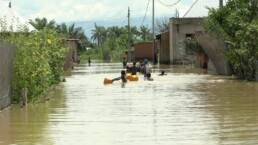
Flooded Residential area Gatumba 2024 (Iwacu)
But this location also makes it vulnerable to the vagaries of a changing climate: the combined effects of rising Lake Tanganyika levels and the Ruzizi River overflowing due to excessive rainfall have led to the flooding of much of the area around Gatumba in successive years, often for months at a time, drastically disrupting life in this border town and beyond.
Over the course of 2024, we conducted an assessment of how members of the local community experienced the loss and damage, as well as how responses to L&D were perceived in the affected community. The floods were devastating in many ways. In 2024, but also in previous years, human lives were lost, either directly as a result of the flooding, or according to authorities, as a result of lethal interactions with wildlife (hippos and crocodiles entering residential areas), or as a result of diseases related to sanitary conditions. We were not able to establish whether people died as a result of medical care facilities becoming inaccessible, which was a major issue for many of the affected families.
Unsurprisingly, our assessment found that the often irreparable loss and damage to private residences and various public and private infrastructure essential to community life was highly disruptive. In addition, and related to infrastructure damage, there were numerous other instances of what is typically referred to as ‘economic loss and damage’ (mostly measurable impacts to which a monetary value can be attached).
Our mapping shows an important dimension of loss and damage which is easily overlooked: effects may be dispersed in space and time. This is for instance very clear when we zoom in on the impact of the prolonged flooding of the Kavimvira border crossing during much of 2024. This caused significant disruption to trade activities, which severely affected the local community of Gatumba, where many people’s livelihoods are linked to cross-border trade, mainly as transport workers. (It is for instance one of the few places in Burundi where people with reduced mobilities can find employment, as transport workers with hand bikes.) These people have seen their jobs dissapear or their income drastically reduced for several months. But the negative impacts are felt far beyond the flooded zone. Exports to DR Congo, especially through Gatumba, are very important for Burundi’s economy, and are a key source of foreign currency. Companies like Brarudi and Savonor, important employers and fiscal contributers, sell a significant share of their products in Uvira and Bukavu. While there is a road in good condition from Cibitoke Province to Bukavu, the Rwanda and Burundi crisis has seen the borders closed since January 2024. The large part of the trade between eastern DRC and Burundi must therefore pass through Gatumba. At the same time, due to persistent fuel shortages, Burundian vehicle owners depend on fuel supplies from Congo. The border closure due to flooding has thus caused severe economic losses, disrupting trade and exacerbating shortages, both in Burundi and across the border.
The same local and beyond local dimensions are present when we look at the so-called non-economic losses and damages (NELD, a term that is not without its problems). The floods had a profound impact on essential aspects of human well-being in and around Gatumba which cannot be easily measured in monetary terms. They include drastic disruptions to education and the decline in the quality of education in those schools that remained open. These effects will have a long lasting negative impact on the current schoolgoing generation. Similarly, the loss of access to vital health services has compromised public health and safety and placed an additional burden on those in need of medical assistance. And again, this doesn’t only affect the local community, it also affects Congolese students and patients who used to rely on these services in Gatumba and mostly, in Bujumbura town. The area around Gatumba is also a famed for its recreational spaces, and the urban dwellers from Bujumbura who used to frequent beaches and bars near Gatumba were deprived of this option for months. Finally, many of the churches and places of spirituality in Gatumba, which are central to many people’s cultural identity, in fostering community life but also as a source of psychological relief, became inaccessible.

Makeshift self-relocation in less affected zones in the area (Iwacu)
We also looked at responses to the climate crisis around Gatumba. Our findings show that efforts to address the losses and damages have been mainly post-hoc and pose significant challenges to climate justice. It is clear that a country like Burundi, recovering from political instability and going through severe economic distress, does not have the resources to deal with losses and damage from recent episodes of climate impacts, nor build resilience and adapt in the face of future climate impacts. While international organizations and donors have stepped in, efforts have been dispersed and the amount of support reaching the affected community is far from sufficient to address the most urgent humanitarian needs, let alone provide more structural redress or compensation for the various forms of loss and damage. More efforts are needed to support communities in Burundi, and this should ideally be done by relying on a diversified instrumentarium, with modalities for addressing recent losses and damages, but at the same time averting further losses and damages in the coming years. In an environment like Gatumba, loans and market-based risk distribution systems such as insurances are not viable options for most households as debts would only risk furthering their vulnerability, especially in the absence of measures to prevent further L&D.
This last point is important. The case of Gatumba shows that it is important not to think of L&D as a ‘last resort’ in climate action, after everything else has failed. Dealing with loss and damage must go hand in hand with efforts to prevent further loss and damage – through mitigation and adaptation. This is articulated by the residents of Gatumba. Even those who lived in the most flood-prone areas of the zone, and whose homes and property were completely destroyed, clearly expressed their desire to continue living in Gatumba and thus to adapt to the situation of recurrent flooding. Indeed, for many of our interviewees there is a strong attachment to the place, which means that they are willing to stay even under less than ideal conditions. This willingness to stay is also evident in numerous instances of bottom-up, unplanned adaptation to living through the floods: from improvised dykes using sandbags to stop the water, to the use of boats as a means of transport within the flooded areas and through the re-introduction of an elevated (called Uburiri bw’Umwami/ the king’s bed, referring to the historic type of bed of used by Burundi’s). Furthermore, the community and local authorities have also proposed ideas for more structural interventions to protect the most vulnerable areas from the water via infrastructural works.
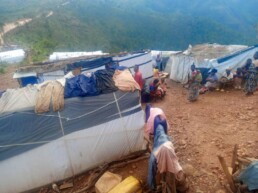
Displaced families in the Gisagara relocation site (Iwacu)
We also looked at responses to the climate crisis around Gatumba. Our findings show that efforts to address the losses and damages have been mainly post-hoc and pose significant challenges to climate justice. It is clear that a country like Burundi, recovering from political instability and going through severe economic distress, does not have the resources to deal with losses and damage from recent episodes of climate impacts, nor build resilience and adapt in the face of future climate impacts. While international organizations and donors have stepped in, efforts have been dispersed and the amount of support reaching the affected community is far from sufficient to address the most urgent humanitarian needs, let alone provide more structural redress or compensation for the various forms of loss and damage. More efforts are needed to support communities in Burundi, and this should ideally be done by relying on a diversified instrumentarium, with modalities for addressing recent losses and damages, but at the same time averting further losses and damages in the coming years. In an environment like Gatumba, loans and market-based risk distribution systems such as insurances are not viable options for most households as debts would only risk furthering their vulnerability, especially in the absence of measures to prevent further L&D.
This last point is important. The case of Gatumba shows that it is important not to think of L&D as a ‘last resort’ in climate action, after everything else has failed. Dealing with loss and damage must go hand in hand with efforts to prevent further loss and damage – through mitigation and adaptation. This is articulated by the residents of Gatumba. Even those who lived in the most flood-prone areas of the zone, and whose homes and property were completely destroyed, clearly expressed their desire to continue living in Gatumba and thus to adapt to the situation of recurrent flooding. Indeed, for many of our interviewees there is a strong attachment to the place, which means that they are willing to stay even under less than ideal conditions. This willingness to stay is also evident in numerous instances of bottom-up, unplanned adaptation to living through the floods: from improvised dykes using sandbags to stop the water, to the use of boats as a means of transport within the flooded areas and through the re-introduction of an elevated (called Uburiri bw’Umwami/ the king’s bed, referring to the historic type of bed of used by Burundi’s). Furthermore, the community and local authorities have also proposed ideas for more structural interventions to protect the most vulnerable areas from the water via infrastructural works
However, they feel that these calls for local adaptation have not been taken seriously by the national government, whose position seems to be that large parts of Gatumba are now a sacrifice zone where people should no longer live. In 2024, the Burundian government’s response has essentially been to relocate households from the affected zones to other places far away from Gatumba. While in some parts of the zone such a managed resettlement may well be a reasonable solution, the non-consensual way in which this resettlement has been carried out has been a major source of frustration. Moreover, the initial relocation site in 2024 was high up in the mountains at Gisagara in Bujumbura Rural, far from the familiar Ruzizi plain. As a result, people who followed the relocation orders often ended up more vulnerable, making this a classic case of ‘maladaptation’. Not only could they no longer rely on familiar livelihoods and agricultural skills suited to life on the Ruzizi plain, but there was also a lack of sufficient support and full access to health and education services. Many eventually returned, and the government itself finally took the initiative to find more suitable sites to host the relocated families. While this new move was welcomed, affected families still struggle to access health and education in these sites.
The case of Gatumba illustrates the challenges of addressing L&D in a climate-just way. Although severely affected, Gatumba is not necesarilly existentially threatened. In the local community, there is a strong desire to remain in larger area around Gatumba. There are plans, with support of the World Bank, to work towards climate resilient rehabilitation of infrastructures and flood protection around Gatumba. If authorities and partners are willing and harmonise their approaches, both preventing and minimizing further episodes as well as dealing with recently incurred loss and damage in an equitable way, they should start by harnessing local will and potential for adaptation to prevent further L&D. Certainly, drastic measures will needed in addition to the community’s own adaptation efforts, both physical interventions and a reorganisation of land use and habitation patterns in the zone, as well as forms of social protection. In terms of the incurred damages, it is possible to repair and rebuild some of the zone’s infrastructure in a more climate-resilient way. Moreover, it is also possible to relocate those families whose land or homes cannot be rebuilt, close to their community or in places close where they are less disconnected from their economic options and livelihood skills.

Anthropocene
the term “Anthropocene” refers to the significant impact of human activities on the earth, affecting everything from climate to biodiversity. this controversial concept has spread from the natural…

Forest
The forest is often imagined as a wooded area, sometimes with or without birds and animals. However, the significance of forests extends beyond the visual experience. this per-ception is greatly…
Agroforestery
Agroforestry is a practice that long predates its recent con-ceptualization and formal recognition as a scientific disci-pline. it is the practice of combining trees or other ligneous plants with…